
From safe spaces to brave spaces
Psychological safety has become one of the most quoted ideas in leadership right now, and for good reason. Amy Edmondson's research is clear about what it actually means:
a shared belief that a team is safe for interpersonal risk taking.
People speak up, challenge each other, admit mistakes, and disagree openly, trusting they won't be punished or humiliated for it.
However, in some workplaces, "safe space" has come to mean a space where nobody gets uncomfortable. Where disagreement is smoothed over, people nod, agree quickly, and withhold saying the thing everyone's secretly thinking.
Edmondson herself warns against this. She's explicit that psychological safety is not the same as group cohesiveness, which can erode people's willingness to challenge each other, the exact conditions that produce groupthink.
This is where brave space becomes useful. Brian Arao and Kristi Clemens coined the term in social justice education, arguing that removing risk from difficult conversations is simply impossible, and pretending otherwise doesn't protect people, it just prevents the growth those conversations were meant to create.
A brave space still holds people with care. It just assumes discomfort will show up and asks for the courage to stay in it rather than the promise that it won't happen.
True psychological safety, as Edmondson defines it, and brave space, as Arao and Clemens define it, are pointing at the same thing. Both ask people to disagree, challenge, and stay present through friction, trusting they'll be met with respect rather than retaliation.
Safe Space vs Brave Space
Lets get clear on the difference. A safe space is where people can openly talk without being challenged, interrupted or blamed. It is great for group circles and trauma or grief processing.
Brave spaces are where people feel safe to make mistakes, challenge one another on their ideas, speak up when something feels off and call out the elephant in the room. Great for when you want to build a high performing team, enhance innovation and increase drive and engagement.
Leader’s role
In a safe space, the leader's job is to soothe and hold boundaries, keeping the team calm and contained. They serve as a facilitator of a conversation.
In a brave space, that job shifts to becoming the one asking the hard question, challenging the thing that's gone unchallenged for too long and inviting other doing the same.
For leaders, this is a difficult transition when they were praised for being the calm, steady presence. Holding a brave space asks them to give up a role that used to earn them credit, and to risk being the person who makes things uncomfortable instead of the one who smooths them over.
Behaviour
In a safe space, people nod along quickly, soften their language before they say anything that might land hard, and conversations stay pleasant.
In a brave space, someone names the elephant in the room. A person asks: "can I push back on that?". When the tension is felt, it’s named, not avoided.
Sometimes it’s hard to miss the trap of operating in a safe space. The safe-space version often looks like a well-run meeting. Nobody's raising their voice, nobody's storming out, everything appears healthy.
That's exactly what makes it hard to catch. The team is leaving things unsaid. If you do that for months and years, over and over again, it compounds without ever announcing itself as a problem.
Outcome
A safe space keeps everyone inside their comfort zone.
A brave space moves people into their stretch zone, gently inviting them forward without pushing them anywhere close to harm.
Bravery isn't discomfort for the sake of it, nor it’s about forcing people past what they can handle. The skill is calibration, reading how far a person or a team can stretch on a given day, and staying just inside that edge rather than either avoiding it altogether or blowing past it.
Who it protects
A safe space tends to protect the comfort of whoever's in the room, often the person speaking up or sharing. When working in the trauma or grief space, this is great and exactly what you want, but if you want your team to optimise the way they work together, it becomes less admirable.
A brave space protects the people who are marginalised or vulnerable. It’s for the people for whom staying quiet and small has always been the safer bet.
A safe space, as it's commonly practiced, can end up defending the status quo.
Brave space asks the room to actively hold safety for the person who has the least of it, which is a very different job than simply avoiding conflict.
When to use it
A safe space earns its place around grief, trauma, and genuine fear of harm. Those moments call for containment, not challenge.
A brave space is for stagnation, avoidance, and the tension everyone can feel but nobody's naming.
The mistake most teams make isn't choosing the wrong one, it's defaulting to safe space for everything, including the moments that actually call for bravery.
Knowing which one is required, and being willing to name that out loud, is its own leadership skill.
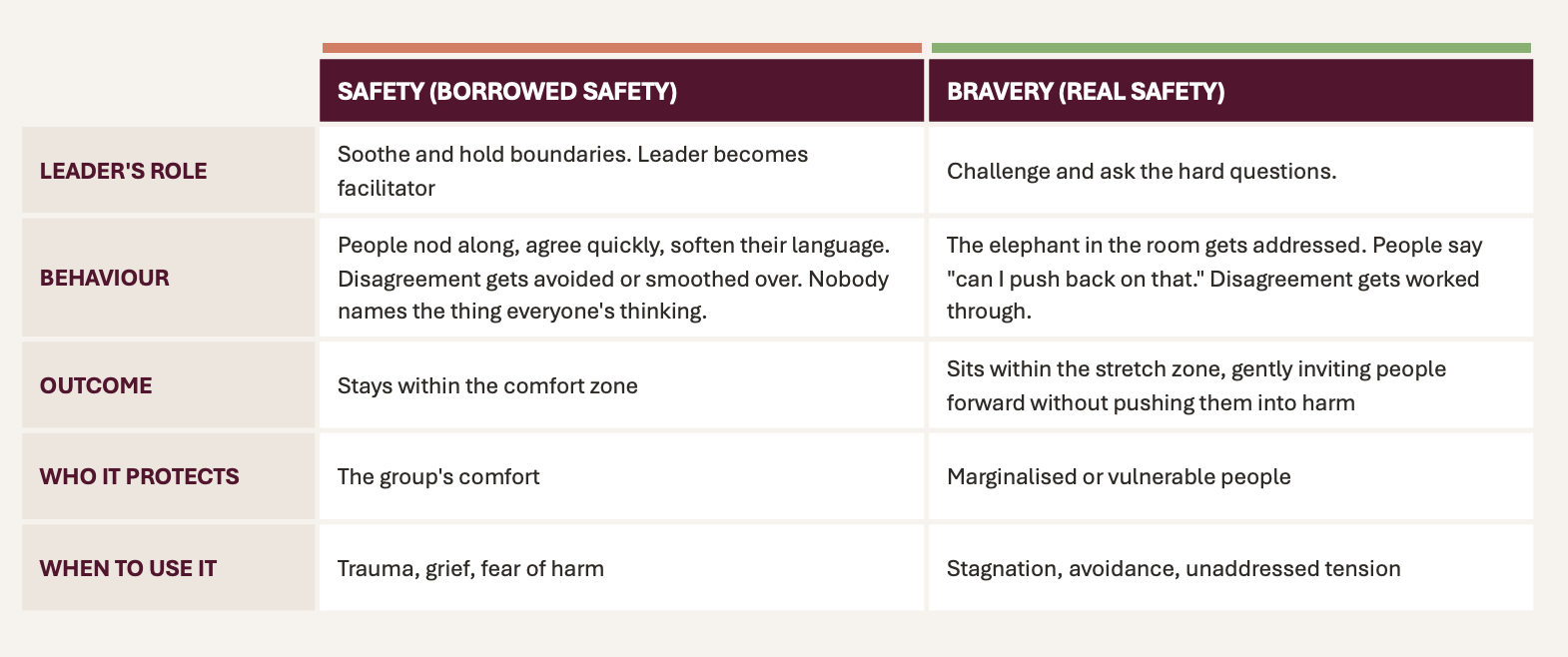
Summary of Safe Space vs Brave Space
